

ACAP leaders join 4th global Terawatt Workshop to plan accelerated, multi-terawatt solar PV deployment
Updated: Jan 15
In late December 2025, Nature Energy published an article penned by ACAP leaders and another ~70 world-leading solar PV experts outlining a strategic global framework for accelerating solar PV deployment as the world enters a multi-terawatt era.
"Historical and future learning for the new era of multi-terawatt photovoltaics" reflects the outcomes of the Fourth Terawatt Workshop (TW4) held at Pacific Grove, California, in June 2024. It charts a path forward based on learning – combining research and development, experience, and global collaboration – and identifies emerging priorities such as tandem technologies, reliability, and sustainability metrics.
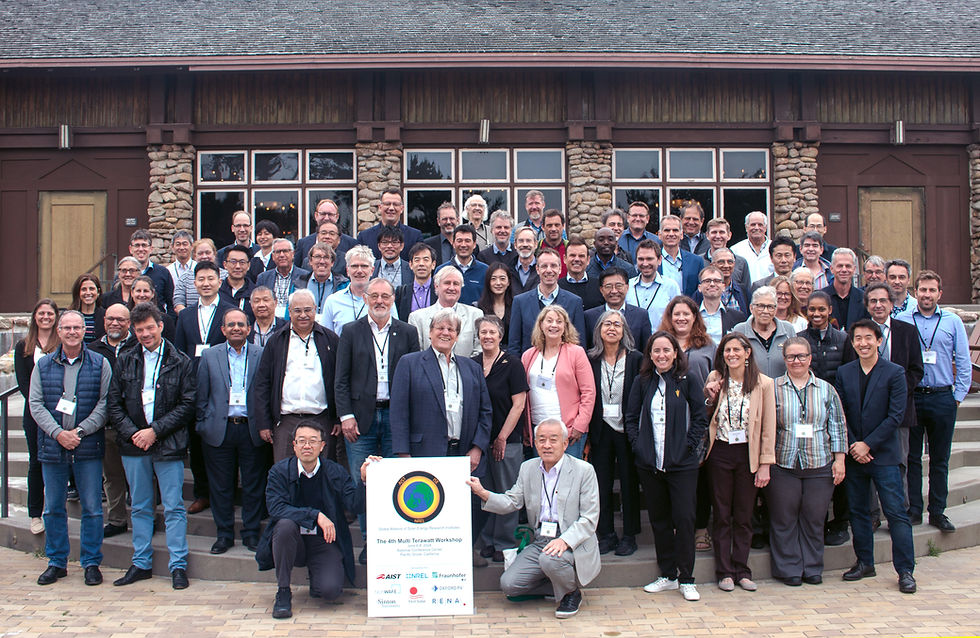
What is the Terawatt Workshop (TW) group?
Every two years, the Terawatt Workshop series gathers a select group of global leaders in solar PV research, industry, and policy to develop strategies for scaling photovoltaic deployment to meet future energy demand, cut carbon emissions, and ensure sustainable, coordinated global growth.
TW4 invited 73 key experts from 56 organisations spanning North America, Europe, Asia, Africa, and Oceania. Among them were ACAP’s Executive Director Professor Renate Egan, UNSW Node Lead Dr Jessica Yajie Jiang and ANU Node Lead Professor Dan Macdonald, along with ACAP industry partners Dr Yifeng Chen (Trina Solar) and Pierre Verlinden (Yangtze Institute for Solar Technology).
Major research groups joining ACAP included: NREL (USA), Fraunhofer ISE (Germany), Trina Solar (China), AIST (Japan), KAUST (Saudi Arabia), YIST (China), Imec (Belgium), and the Indian Institute of Technology Bombay (India).
Key insights from the Nature Energy article:
• Historical learning as a foundation
Today’s scale of PV deployment is the result of five decades of cumulative advances in PV cost, efficiency, and reliability. The experience curve – linking cost reductions to cumulative production – has been accelerated by global collaboration, R&D breakthroughs, and knowledge sharing across regions and companies.
• The scale of the challenge ahead
Global PV deployment reached 2 TW by the end of 2024, with 550 GW installed in 2024 alone – more than all installations before 2018. Annual installations are expected to rise to 600–700 GW in 2025, and projections exceed 75 TW by 2050, requiring manufacturing capacity to grow to around 3 TW per year. This scale-up must occur without compromising sustainability, resource availability, or reliability.
• Emerging technologies and learning needs
Tandem solar cells, particularly perovskite/Si architectures, offer efficiency gains beyond the limits of single-junction silicon. However, they face hurdles in reliability, scalability, and cost competitiveness. These technologies will need accelerated learning curves, informed by lessons from Si, CdTe, CIGS, and III-V technologies.
• Sustainability metrics take centre stage Future PV progress will be measured not only by cost and efficiency but also by environmental and social metrics:
– material sustainability (reducing silver and silicon usage)
– energy and water consumption in manufacturing
– design for recycling and circularity
– net impact on CO₂ emissions.
These factors will shape R&D priorities and influence technology adoption.
• Reliability and lifetime
Extending module lifetimes and ensuring durability under diverse climate conditions is critical for cost-effectiveness and reducing replacement needs. New technologies must meet or exceed current reliability standards to gain market acceptance.
Developing robust, globally harmonised testing standards is essential to ensure the reliability and bankability of next-generation PV technologies, particularly as new module designs and tandem architectures introduce unfamiliar degradation modes.
• Global collaboration as a catalyst
The pace of innovation and deployment depends on coordinated global efforts – sharing data, harmonising standards, and pooling resources for R&D and testing. The TW4 consensus emphasises that no single region or company can achieve terawatt-scale sustainability alone.
Upon publication of the paper, Professor Renate Egan said, “Australia is already a global leader in renewable energy, with solar meeting nearly 20% of national electricity needs in 2024 – a figure that has doubled in five years. Maintaining this momentum will help achieve the national target of 82% renewable electricity generation by 2030.”
“ACAP’s engagement in TW4 and contribution to the Nature Energy article demonstrates our role guiding the global PV community towards sustainable, large-scale deployment – and positioning Australia as a renewable energy superpower." – Professor Renate Egan.
The June 2024 TW4 was convened by NREL, (US), AIST (Japan) and Fraunhofer ISE (Germany).
Read the article, ‘Historical and future learning for the new era of multi-terawatt photovoltaics’, Nature Energy, December 2025.
DOI number: 10.1038/s41560-025-01929-z.


Thank you for the detailed and well-organized article. The discussion on online entertainment platforms highlights their growing role in content delivery. Additional background on this topic may be found on the website . The examples provided help clarify the broader industry trends.