Inkjet printing brings simpler manufacturing of high-efficiency back contact solar cells a step closer
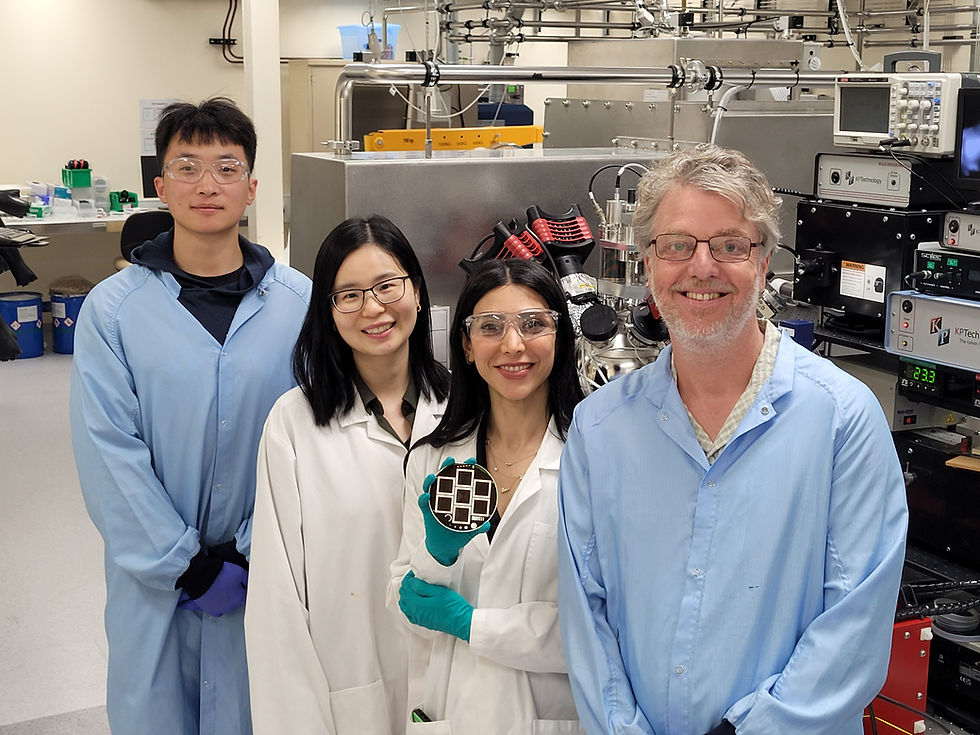
TOPCon interdigitated back contact (TBC) solar cells have demonstrated high efficiencies of 26.1 per cent in the laboratory and above 27 per cent in large-area industrial devices, but the complexity of manufacturing them has limited their wider adoption [1, 2]. A sustained body of work led by Dr Jiali Wang at the Australian National University (ANU) is advancing a potentially simpler way to make these high-efficiency cells, using precision inkjet printing to form patterned poly-Si passivating contacts on the rear side of solar cells.

Unlike conventional solar cells, interdigitated back-contact (IBC) cells place all electrical connections on the rear, leaving the front surface clear to capture more sunlight. However, creating the intricate alternating positive and negative contact patterns on the rear requires precise and carefully controlled manufacturing processes [1, 6]
Wang's research has explored whether inkjet printing could provide a simpler alternative to conventional patterning techniques – potentially reducing costs and streamlining production processes.
The work is supported by ACAP and ANU's ARENA-funded TRAC project, Next Generation Silicon Solar Cells: Greater than 26% Efficiency in Mass Production, a collaboration involving the University of Melbourne, Jinko Solar and CAMECA [7]. The research has drawn on advanced materials characterisation to understand and improve the printing process.
Across four publications between 2023 and 2026, the research has progressively demonstrated the technique's capabilities and addressed an important manufacturing challenge. Initial studies established that inkjet printing could form localised phosphorus-doped contacts, before extending the approach to boron-doped contacts [3,4]. The team also demonstrated that both types could be formed together in a single annealing step, simplifying the manufacturing of IBC cells [5, 6].
However, further investigation revealed some dopant material could migrate beyond the printed patterns during annealing, contaminating areas intended to remain undoped [5], and potentially lowering efficiency.
In Wang’s latest study, published in 2026, she and her collaborators demonstrated that applying a spin-on silicon oxide capping layer across the wafer after printing could substantially suppress both unintended doping and cross-contamination. [6].Next steps include testing alternative capping and dopant materials, as well as lower-temperature processing, to further reduce unwanted doping and improve contact performance. A key milestone will be integrating the optimised inkjet printing process into complete TBC solar cells to assess efficiency, reproducibility and scalability, and its compatibility with industrial manufacturing.
Wang has presented the research at international photovoltaic conferences, and it’s been recognised through several academic awards. In 2026, she received the Wiley Poster Award at WCPEC-9 in South Korea, and in 2025 she was awarded the ANU Solar PhD Thesis Prize. In 2022 she won awards for oral presentations at PVSEC-33 and the APSRC.
References
Haase, F. et al. (2018). “Laser Contact Openings for Local Poly-Si-metal Contacts Enabling 26.1%-Efficient POLO-IBC Solar Cells.” Solar Energy Materials and Solar Cells. https://doi.org/10.1016/j.solmat.2018.06.020
Green, M. et al. (2026), “Solar cell efficiency tables: Version 68.” Joule. https://doi.org/10.1016/j.joule.2026.102494.
Wang, J. et al. (2023). “Development of Phosphorus-Doped Nanoscale Poly-Si Passivating Contacts via Inkjet Printing for Application in Silicon Solar Cells.” ACS Applied Nano Materials. https://doi.org/10.1021/acsanm.2c04148
Wang, J. et al. (2024). “Inkjet-printed boron-doped poly-Si/SiOx passivating contacts.” Solar Energy Materials and Solar Cells. https://doi.org/10.1016/j.solmat.2024.112928
Wang, J. et al. (2025). “Characterizing Inkjet-Printed Localized n+ and p+ Poly-Si Passivating Contacts for Silicon Solar Cells: Comparisons and Insights.” ACS Applied Materials & Interfaces. https://doi.org/10.1021/acsami.5c05734
Wang, J. et al. (2026). “Spin-On SiOx-Assisted Inkjet Printing for Interdigitated n+ and p+ Poly-Si/SiOx Contacts in Silicon Solar Cells With Suppressed Unintended Doping.” Advanced Materials Technologies. https://doi.org/10.1002/admt.202501503
Australian National University (2024). Next Generation Silicon Solar Cells Greater than 26% Efficiency in Mass Production: Interim Public Dissemination Report. ARENA Project 2022/TRAC004. https://arena.gov.au/assets/2024/08/ANU-Next-Gen-Si-Solar-Cells-Above-26pc-Eff-Interim-Public-Dissemination-Report.pdf