

Shaping global practice – ACAP’s influential Device to Module Program in 2025
A snapshot of challenges, progress and highlights in ACAP's Device to Module Program in 2025.
Solar cells make the headlines, but it’s modules – the panels in the field – that must survive heat, UV, damp, dust, salt, hail and decades of use. ACAP’s Device to Module program is about bridging that gap: turning cutting‑edge cells into reliable, sustainable, bankable modules and systems.
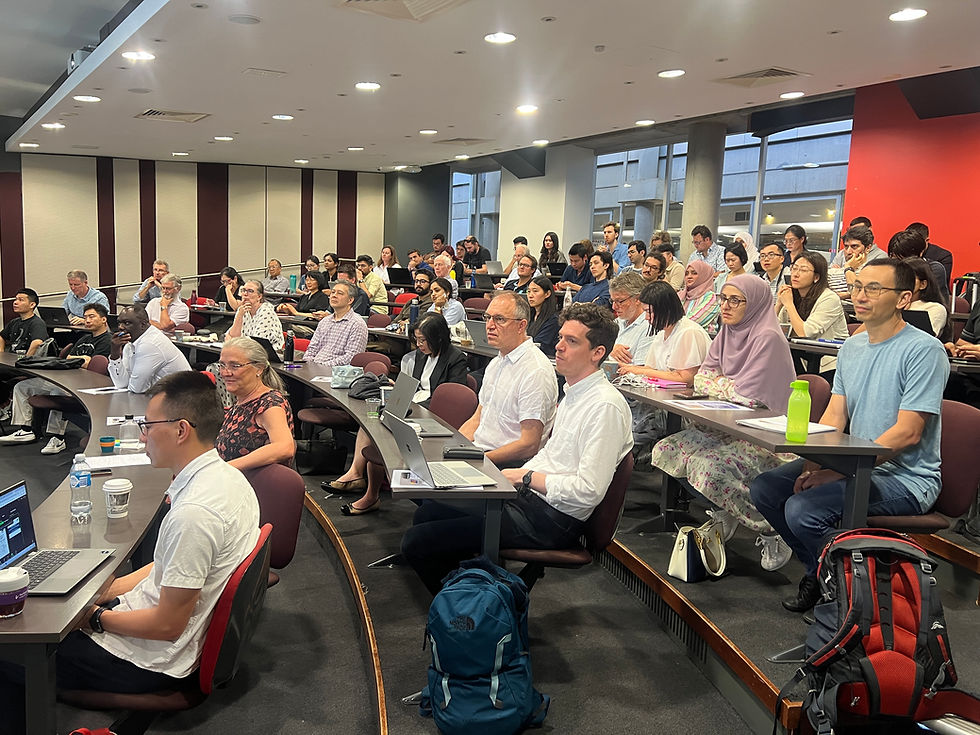
At the 2025 ACAP Conference in December, Dr Muhammad Umair Khan (UNSW) presented on behalf of Device to Module Program Lead Professor Bram Hoex (UNSW), describing a landscape of relentless cost pressure and rapid change.

Today’s rapidly evolving cell technologies and bill of materials (BOM) choices are impacting how full modules behave in the field. At terawatt scale, it’s no longer enough to optimise just the cell or just the module; the cell–module interaction and real‑world degradation become central.
Technology status
Dr. Khan linked the sub‑US$0.10/Wp module price to aggressive BOM and design changes:
Materials being thinned and substituted: glass and frames are getting thinner; encapsulant POE (Polyolefin Elastomers) is being replaced by POE/EVA (Ethylene-Vinyl Acetate) blends (EPE); steel frames and frameless designs are emerging.
New cell types drive new constraints: TOPCon, back‑contact and bifacial bring UV sensitivity, corrosion issues and low‑temperature metallisation questions that were not as critical in older designs.
Module sizes and weights have scaled up fast for utility‑scale, which affects mechanical and reliability behaviour, not just logistics.
At the same time, there’s a growing emphasis on long‑term performance, not just headline efficiency, because modules are expected to survive 25–30 years in increasingly harsh environments to enable the lowest levelized cost of electricity (LCOE).
Challenges in ACAP's Device to Module program
Dr. Khan described the following practical problems that he and colleagues at research institutions such as ACAP are facing.
Keeping up with industry
Cell and module formats, plus BOMs, change so quickly that the required infrastructure for fabrication and testing is constantly lagging. By the time a specific failure is fully understood, the industry has often already shifted to a new BOM, so the window to investigate or mitigate its impact is narrow.
Missing and underestimated failure modes
Issues that emerge from the combination of advanced cells and cost‑driven BOMs include UV-Induced degradation (UVID), corrosion, abrasion, light‑induced, thermal and potential‑induced degradation.
In the lab, they typically stress modules with only UV, heat, or humidity, but in the field all of these occur together. Umair noted that the current IEC UV test is equivalent to only 56 days in the Australian outback, which is clearly not representative of decades in that environment.
Complexity of real energy yield
With these new module concepts and materials, the simple assumption that higher nameplate power equals higher energy yield no longer holds; temperature coefficients, degradation rates and spectral response all play a larger role and should be considered to ascertain the true yield.
Opportunities
Dr. Khan argued that ACAP can move quickly with relatively modest investment to do the following:
Upgrade module‑level fabrication and testing to be state‑of‑the‑art, as a complement to ACAP’s already strong device work. This will be used to support domestic module makers and developers.
Test new BOMs and emerging cell technologies (including tandems) in realistic ways before or alongside commercial adoption.
Co‑develop novel module architectures with industry partners.
Outdoor testing – the Australian advantage
Dr. Khan highlighted the expansion of outdoor test facilities, with current and potential sites at CSIRO, ANU, UNSW and the Desert Knowledge Centre (DKC) in Alice Springs. These sites cover different UV, humidity, soiling and temperature regimes, allowing ACAP researchers to: 1. see how both commercial and proof‑of‑concept technologies degrade 2. validate and refine diagnostic tools and modelling approaches so that lab tests and standards better match reality.

Highlight – Reduced silver consumption (UNSW)
Silver scarcity is a key bottleneck to terawatt scaling of solar photovoltaics and Umair highlighted UNSW’s silver‑lean dash design, which cuts silver use to about 2 mg/W per side (~84% reduction), while maintaining efficiency and not requiring advanced printing. He noted its compatibility with TOPCon/SHJ production lines and the potential for ~US$30B annual savings at scale.
This is a key example of device‑to‑module, material‑aware innovation that is directly aligned with the program’s aims.
HIghlight – UV‑induced degradation (UNSW) and IEC testing standards
Dr. Khan described UVID in TOPCon and SHJ as a major, metastable degradation mode that puzzled the industry, especially the observation that degradation can continue in the dark after UV exposure.
ACAP-supported UNSW researchers were the first to present the full UVID mechanism in TOPCon, including the interplay between the interface defect and the fixed negative charge density, and to find that thicker atomic-layer-deposited (ALD) aluminium oxide outperforms a thinner layer. This type of study lays the groundwork for IEC testing standards by establishing a testing sequence that can predict outdoor performance. We are now working with IEC to ensure this understanding is reflected in the updated UV test standards.
The presentation positioned the Device‑to‑Module program as the bridge between advanced cell/device work and robust, field‑relevant modules and standards, using Australia’s conditions and ACAP’s capabilities to shape global practice.


Comments