

Snapshot of Progress and highlights for ACAP’s solar PV Manufacturing and Sustainability Program, 2025
To reach multi-terawatt scale, the solar industry must manage a set of tightly linked pressures. These include reliance on finite materials, energy-intensive manufacturing processes, complex and sometimes fragile international supply chains, growing waste streams, and the need to maintain high system performance over long operational lifetimes. Failure in any one of these areas risks undermining the climate and economic benefits of solar power.
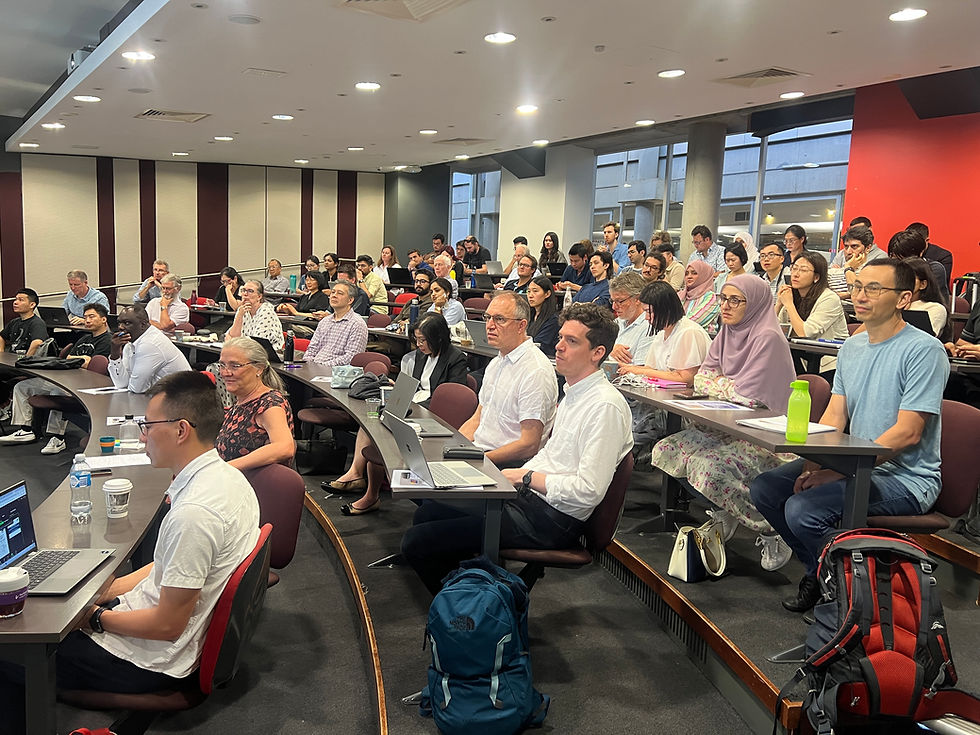
At ACAP’s December 1 Conference, Dr Chris Fell (CSIRO) Technical Lead for ACAP’s Manufacturing and Sustainability Program Package described how ACAP is directly addressing these challenges, with research across manufacturing, techno-economic analysis, life-cycle assessment, recycling, reuse and performance modelling to tackle these issues as a connected system rather than in isolation.

Key challenges and opportunities
Material scarcity
Critical materials such as silver, indium and bismuth face supply limitations at projected deployment scales, while other inputs remain sensitive to supply-chain disruption. PP5 research explores pathways to reduce reliance on constrained materials and to better understand material risks embedded in global manufacturing systems.
Embodied energy
Around half of a solar module’s embodied energy currently comes from silicon wafer production, with significant additional contributions from aluminium frames, glass, copper and steel. PP5 work highlights opportunities to reduce emissions through process improvements and by decarbonising upstream material production.
Waste management
Manufacturing waste – including kerf losses, yield losses and chemical waste – requires active management. Looking ahead, the program addresses the emerging issue of end-of-life PV modules. PP5 research asks whether recycling can become truly circular – returning materials into new solar products – and whether large numbers of functional but displaced modules can be safely and economically reused.
Domestic manufacturing
The program explores what level of vertical integration might be required, how manufacturing could remain viable as it scales from a small base, and whether partial or complete independence from global supply chains is achievable in the Australian context.
Highlights from 2025 in PV manufacturing and sustainability
From research to commercial impact
ACAP-supported laser-induced delamination technology for PV module recycling has progressed towards commercialisation through Hello Again Solar, a UNSW spin-out company. The technology has moved into commercial design, with a pilot facility planned. The company has also attracted private investors, partners and customers, demonstrating how ACAP-enabled research can translate into practical circular-economy solutions.
Rethinking circularity for photovoltaics
In a paper chosen as one of the best for 2025 by Cell Reports Physical Science, PP5 researchers proposed new circularity indicators that move beyond mass-based material flows. Because PV systems generate energy throughout their operational life, assessing energy circularity reveals benefits that material-only metrics miss. This approach shows that PV can achieve near-ideal energy circularity even where material circularity is limited, while also capturing technology improvements, changing demand and avoided energy losses.
Techno-economic and life-cycle analysis
Significant progress was made in modelling and analysis, including:
• Cost analysis of metallurgical silicon production in Australia (ANU/UNSW), presented at EUPVSEC 2025.
• LCOE analysis of silicon–perovskite tandems and suitable silicon bottom cells, currently under journal review.
• LCOE analysis of alternative pathways to achieve ARENA’s 30-30-30 targets, presented at APSRC 2025.
• Life-cycle assessment of PV glass recycling pathways, with a publication under review.
• Participation in ARENA’s Sunshot feasibility study led by Energus, examining a potential polysilicon project in NSW.
• International engagement through EUPVSEC 2025, analysing the impact of recent EU policies on PV manufacturing.
Improving system performance and lifetime
PP5 delivered advances in performance modelling, including improved thermal models for tracking systems that account for local shading, radiative effects and transient behaviour. New intrinsic-adjusted electrical models demonstrated significantly improved fitting accuracy on industry partner cells, alongside proof-of-concept work on tracking algorithms designed to reduce thermal stress. New modelling approaches were also developed to quantify UV exposure of modules under real field conditions.
Enabling PV module reuse through data and diagnostics
A major milestone was securing the world’s largest known dataset of I-V curves and electroluminescence images from used PV modules with known operating histories. This dataset is being used to train machine-learning tools for rapid “triage” of decommissioned panels — sorting modules suitable for reuse from those destined for recycling. The long-term aim is deployable systems that support reuse at scale while meeting safety, logistical and regulatory requirements.


Comments