

Silicon PV at a crossroads: Landmark paper provides insights from Professor Martin Green and global industry decision makers
The Australian Centre for Advanced Photovoltaics (ACAP) is proud to highlight the publication of a landmark analysis in prestigious journal Joule titled "State-of-play of contending silicon photovoltaic technologies"1, authored by Professor Martin Green alongside notable co-authors Dr Jessica Yajie Jiang, Dr Ning Song and Dr Zibo Zhou (UNSW/ACAP), and industry heavyweights from Aiko, LONGi, Huasun, JA Solar and Trina Solar.
Silicon solar cells account for over 97% of the global PV market, thanks to relentless cost reductions and efficiency improvements. This seminal paper examines the evolution of silicon PV technologies and the competitive landscape shaping the future of solar energy.
It brings together expertise spanning both laboratory innovation and gigawatt-scale manufacturing. Contributing authors from Aiko, LONGi, Huasun, JA Solar and Trina Solar represent a substantial share of global module production. All of them are members of the ACAP Industry Consortium, highlighting the depth of trust and collaboration ACAP has established with the world’s leading PV manufacturers.
Solar photovoltaics have transformed global energy systems over the past decade, with annual installations skyrocketing to 600 GW in 2024 – a staggering 30% annual growth since 2014. From 2025 onwards, solar will generate more electricity worldwide than nuclear or wind, cementing its role as the cornerstone of the clean energy transition.
"Silicon photovoltaics have delivered some of the cheapest electricity in history, and the pace of innovation shows no signs of slowing. As we move toward even higher efficiencies and explore tandem technologies, the industry stands at an exciting crossroads." – Professor Martin Green
The five defining silicon solar technologies behind PV’s evolution to 26% efficiencies
In Joule, Professor Green and co-authors lead an in-depth exploration of the industry development over five major silicon cell architectures.

Al-BSF (Aluminium Back Surface Field): The rugged workhorse that dominated for nearly 40 years (1975-2018), producing module efficiencies just over 12%.
PERC (Passivated Emitter and Rear Cell): Displaced Al-BSF in 2018 and achieved >90% market share by 2021. In 2022, PERC delivered a boost in module efficiencies to 21.6%.
TOPCon (Tunnel Oxide Passivated Contact): Is dominating production in 2025, with modules 22.1%-23.5% on offer across the top twenty manufacturers.
HJT (Heterojunction): Shown to deliver another boost in efficiency, with record module efficiencies up to 25.4%, however increased complexity results in cost challenges, particularly in capital for equipment.
IBC (Interdigitated Back Contact): With all contacts on the rear and record efficiencies of 27.9% for cells and 26.0% for modules, IBC is positioned to be the next major technology transition.
These advances over the last twenty years underscore the accelerating pace of innovation and the growing importance of wafer quality, cell design and advanced passivation techniques.
Single junction silicon cell technologies are expected to dominate manufacturing for the next ten years, with ongoing price reductions.
Tandem cells: the long-term frontier
The paper examines progress with technologies beyond silicon, reviewing the leading contender: silicon-based tandem cells, particularly perovskite-silicon combinations that are achieving up to 35% efficiency in the lab. Stability challenges, however, remain a barrier to commercialisation with perovskite-based technologies.
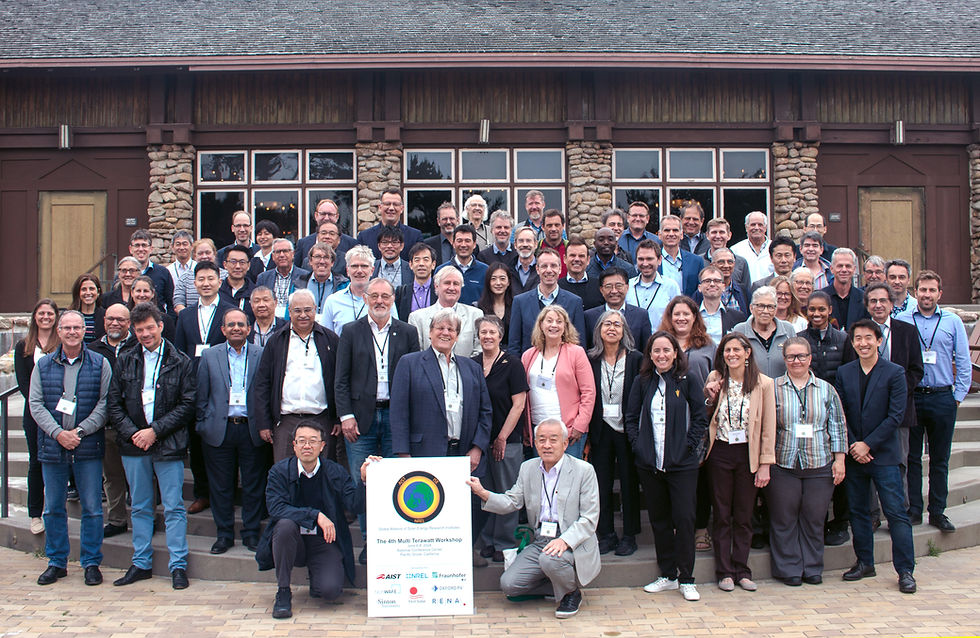
[Another recent paper by around 70 world leading solar experts, including Dr Jessica Yajie Jiang and ACAP Executive Director Renate Egan, “Historical and future learning for the new era of multi-terawatt photovoltaics”, predicts delays to 2035 and beyond before perovskite tandems offer a competitive commercial solution.]
As occurred with silicon technologies, tandem technologies are expected to benefit from use of alternative materials, processes and cell designs.
Professor Green and co-authors forecast: “If photovoltaics attains its full potential, silicon will disappear as a mainstream photovoltaic material” as multi-junction stacks and novel concepts like hot-carrier cells redefine photovoltaics.
The road ahead
With costs continuing to fall and efficiencies climbing, silicon PV will remain central to global decarbonisation efforts for years to come. Yet, as this seminal paper demonstrates, the industry is still young and the technology continues to develop. We can expect future technology transitions to advanced silicon architectures and, further ahead, entirely new materials.
ACAP is delivering global impact through high-impact, elite publications
This industry-backed publication complements an opinion piece2 by Professor Martin Green published in the highly-prestigious Nature Energy in the same month, “Advances in the performance and adoption of solar photovoltaics”, as well as the global TW4 ‘think-tank’ publication3 on the era of multi-terawatt photovoltaics also in Nature Energy 4 in December 2025, with co-authors from ACAP.
References:
1. Green, M. A., Zhou, Z., Song, N., Qiu, K., Xu, X., Wang, W., Ouyang, Z., Chen, Y. & Jiang, J. Y. (2025). “State-of-play of contending silicon photovoltaic technologies”. Joule. https://doi.org/10.1016/j.joule.2025.102240
2. Green, M.A. “Advances in the performance and adoption of solar photovoltaics”. Nat Energy 11, 7–8 (2026). https://doi.org/10.1038/s41560-025-01880-z
Alberi, K., Peters, I.M., Verlinden, P. et al. "Historical and future learning for the new era of multi-terawatt photovoltaics". Nat Energy 11, 38–46 (2026). https://doi.org/10.1038/s41560-025-01929-z

Comments